Tekke Bird Asmalyks
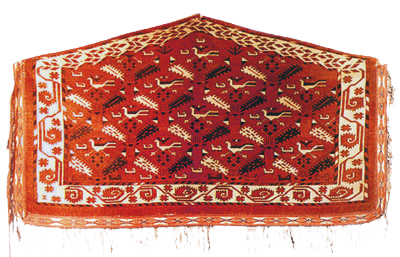
For what purpose were Tekke Bird Asmalyks woven?
Read More...
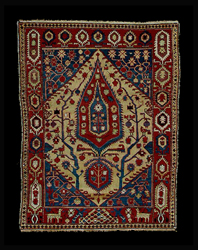
In the sixteenth century the Tekke were a minor tribe surrounded by the Sariq, the Ersari, and the Ata. All of these tribes were subject to the Dashqi Salor Confederation which is sometimes referred to as the Outer Salor. In this paper I discuss a theory concerning the fate of one prominant sixteenth century Tekke clan.
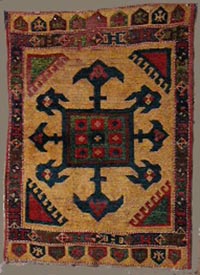
Marla Mallet wrote the following sentence at the end of her description of an antique Yahyali prayer kilim. "One note for die-hard Turkmen enthusiasts: The Yahyali area was one place supposedly settled by early Salor migrants in Anatolia. It's not the Salor weaving you would expect, is it?!"
Source of Quote
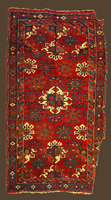
The glossary provides some educational information about Turkoman rugs, Anatolian rugs, and Caucasian Rugs.
Read More...
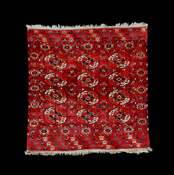
The function of small Tekke rugs employing main carpet gulls in traditional Turkmen society has never been elucidated nor written about to a significant degree. I think these rugs were used by high ranking males to sit on at opportune or auspicious times. I suspect the number of truly traditional Tekke small rugs with main carpet gulls parallels that of traditional Tekke main carpets. If this is so then there must be far more small Tekke rugs with chuval gulls since they were used by Tekke brides receiving guests before the wedding.
An enigmatic and obviously very old Yomud asmalyk, housed at The Museum of Decorative Arts in Paris, France; may have iconography derived from certain 17th century Mughal designs. The asmuldyk was last exhibited at the Cultural Center de Boulogne-Billancourt ( near Paris ) from January 26 to March 26, 1982. Afterwards a magazine reviewer wrote," The piece is an extraordinary early Yomut asmalyk, unique in the zoomorphic quality of its plant motifs and with a large trefoil border."
Read More...
 In my study of Turkmen ethno-history and in my travels to their ancient lands I've built up an image of an alien type or form of human being. No less strange to us today than something visiting us from another world. The Turkmen, or nomadic, way of life was very seductive to Chinese peasants who saw the nomads freedom as a wonderful alternative to their heavily taxed and mortgaged lives. The Chinese ran several different waves of these nomads from their Northern border regions all the way until they were all lost in the trackless wastelands of Central Asia. I suspect Central Asia served as the melting pot for nomadic warrior societies being pursued by much larger and better equipped military forces. The persecution of these nomads resulted in the diversity and richness of pre-modern Turkmen life and their rich weaving traditions.
Read More...
When Linda and I lived in Brooklyn, New York, in the 1990's many collectors and dealers came around to see us. I was known as a Turkoman connoisseur, collector, and writer. One very colorful visitor was Peter Saunders. Peter wrote a very nice book on tribal weaving, Saunders, Peter E. Tribal Visions , before most of us had ever given Oriental Rugs a second thought. Peter Saunders is a highly talented and brilliant rug scholar whose brilliance is sometimes overshadowed by his unconventional and somewhat eccentric joie de vie. Peter consulted to Christie's on their rug catalogue for years and did a fine job in my opinion.
Read More...
I presented this paper to the "Symposium on Cultural Affairs Concerning Classical Culture" in Askhabad, Turkmenistan, in October of 2000. Along with other rug scholars from many other countries, I was there at the invitation of Turkman Bashii, the supreme ruler of Turkmenistan. We were invited to travel to Turkmenistan to help their "scholars" ascertain the true nature of the classical Turkoman culture. The government had realized their Turkoman cultural experience had been obscured through over 100 years of Russian control. The following paper was delivered to a small select group of Turkmenistan's most learned rug scholars along with Elena Tsareva and the attending German collectors. It was a most enjoyable experience and I hope you enjoy reading it.
Read More...
If you want more information, would like to see additional views, or desire something in particular; please send me a message. Your comments and suggestions are welcome.
abey2@comcast.net
(423) 629-7186
I have collected Turkomen weaving since the late 1970's along with other types of ethnographic art. I've published interesting articles in Hali and Ghereh magazines, Oriental Rug Studies V, lectured at the International and the National Conferences on Oriental Rugs, and even played varsity football on scholarship at Jacksonville State University, 1969-70. Somehow managing to later graduate cum laude in molecular biology, from the University of Tennessee, Knoxville, in 1973, I went on to become a popular poet at ABC NOREO off Remsen street in the East Village of New York City. I am very proud of the fact that I C-14 tested and verified the first 17th century Turkoman artifact on record. I once had a flourishing business in Brooklyn, NY, and now reside down South in pleasant Chattanooga, Tennessee. You can reach me by phone at (423) 629-7186.
Read More...
Hello, I'm Jim Allen and I'd like to welcome you to a-bey.com online. This website contains information about Turkomen rugs, Anatolian rugs, and Caucasian rugs along with many pages listing Oriental rugs, Turkoman rugs, Caucasian rugs, Navajo rugs, Anatolian kilims and Caucasian kilims currently for sale. Over the years I have lectured at national and international conferences on Oriental rugs and published articles in Hali magazine, Ghereh magazine, and Oriental Carpet and Textile Studies 5. I concentrate on quality, not quantity; so linger awhile scanning through the pages. This website is constantly undergoing renovations, so pardon me for any inconveniences.